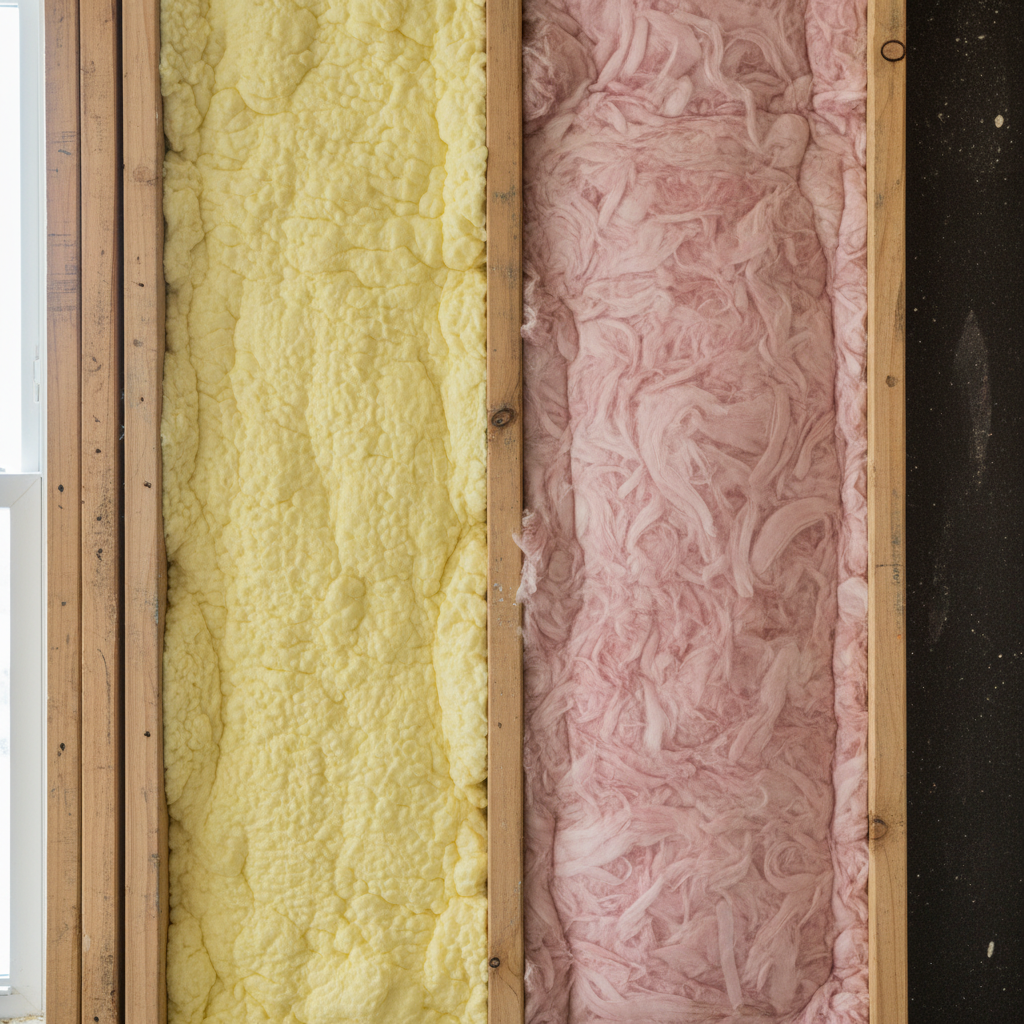
Open Cell vs Closed Cell Spray Foam: Which Is Right for You?
Not all spray foam is the same. Here's how open cell and closed cell spray foam compare on R-value, cost, moisture resistance, and best applications for NY and NJ homes.

When homeowners and contractors in Rockland County, NY, Bergen County, NJ, and Westchester County, NY start researching spray foam insulation, one question comes up almost immediately: what's the difference between open cell and closed cell spray foam? Both are polyurethane-based, both are applied as a liquid that expands on contact, and both outperform traditional insulation materials in air sealing. But they behave very differently once cured — and choosing the wrong type for your application can mean underperforming insulation, moisture problems, or unnecessary cost.
This guide breaks down exactly how each type works, where each one excels, and how to decide which is right for your project.
What Is Open Cell Spray Foam?
Open cell spray foam is a lower-density foam in which the tiny cells that form during the curing process are intentionally left open and interconnected. This gives the cured foam a soft, spongy texture — similar in feel to a foam mattress. Because the cells are open, air can move through the material, which means open cell foam is not a vapor barrier on its own.
R-Value and Performance
Open cell spray foam delivers approximately R-3.5 to R-3.8 per inch of thickness. To achieve a code-minimum R-13 in a 2×4 wall cavity, you'd need roughly 3.5 inches of open cell foam — which fits comfortably within a standard stud bay.
Because it expands aggressively (up to 100 times its liquid volume), open cell foam fills irregular cavities, gaps around wiring and plumbing, and hard-to-reach spaces thoroughly. It is an excellent air barrier even though it is not a vapor barrier.
Best Applications for Open Cell Spray Foam
- Interior wall cavities (2×4 and 2×6 framing)
- Interior side of roof decks (cathedral ceilings, attic conversions)
- Sound dampening between floors and rooms
- Interior basement walls in conditioned spaces
- Budget-sensitive projects where vapor barrier performance is not required
Pros and Cons of Open Cell Spray Foam
Pros:
- Lower material cost than closed cell
- Excellent air sealing and gap-filling
- Good sound attenuation
- Expands to fill complex cavities completely
- Allows walls to "breathe" — can be beneficial in some assemblies
Cons:
- Lower R-value per inch than closed cell
- Not a vapor barrier — requires a separate vapor retarder in some climate zones
- Not suitable for exterior or below-grade applications
- Absorbs water if exposed to bulk moisture
What Is Closed Cell Spray Foam?
Closed cell spray foam is a higher-density foam in which the cells are fully enclosed and filled with a blowing agent gas rather than air. The cured foam is rigid and firm — it does not compress under finger pressure. Because the cells are sealed, closed cell foam resists vapor and liquid water transmission, making it both an air barrier and a vapor barrier.
R-Value and Performance
Closed cell spray foam delivers approximately R-6.0 to R-7.0 per inch — nearly double the R-value of open cell at the same thickness. Two inches of closed cell foam in a rim joist, for example, delivers roughly R-12 to R-14 while also sealing air and blocking vapor.
Closed cell foam also adds measurable structural rigidity to the assembly it's applied to. In wall panels and roof decks, this can meaningfully increase racking resistance.
Best Applications for Closed Cell Spray Foam
- Crawl space foundation walls and rim joists
- Exterior-facing wall cavities (especially in high-moisture climates)
- Under-slab and below-grade applications
- Roof decks and low-slope roofing assemblies
- Flood-prone areas where moisture intrusion is a risk
- Metal buildings and commercial structures
- Anywhere a vapor barrier is required by code or assembly design
Pros and Cons of Closed Cell Spray Foam
Pros:
- Highest R-value per inch of any common insulation material
- Acts as both air barrier and vapor barrier
- Adds structural strength to walls and roofs
- Resistant to bulk water and moisture absorption
- Suitable for exterior, below-grade, and high-humidity environments
Cons:
- Higher material and installation cost than open cell
- Less expansion — requires more precise application to fill irregular cavities
- Rigid when cured — can crack if the structure shifts significantly
- Higher global warming potential from blowing agents (though next-generation low-GWP formulations are increasingly available)
Open Cell vs Closed Cell: Side-by-Side Comparison
| Feature | Open Cell | Closed Cell |
|---|---|---|
| R-value per inch | ~R-3.5–3.8 | ~R-6.0–7.0 |
| Air barrier | Yes | Yes |
| Vapor barrier | No | Yes |
| Moisture resistance | Low | High |
| Structural strength added | Minimal | Moderate |
| Expansion ratio | ~100x | ~30–40x |
| Relative cost | Lower | Higher |
| Best use case | Interior walls, sound, budget | Crawl spaces, exteriors, roofs |
| Suitable below grade | No | Yes |
| Suitable in flood zones | No | Yes |
When to Choose Open Cell Spray Foam
Open cell is the right choice when you need excellent air sealing and thermal performance in an interior, protected application — and when budget is a factor.
Interior wall cavities are the most common application. In a standard 2×4 or 2×6 framed wall, open cell foam fills the cavity completely, seals every gap around electrical boxes and plumbing penetrations, and delivers solid thermal performance at a lower installed cost than closed cell.
Sound dampening is another area where open cell outperforms closed cell. The soft, interconnected cell structure absorbs sound energy more effectively than rigid closed cell foam, making it a popular choice between floors, around home theaters, and in party walls between units.
Attic conversions and cathedral ceilings — applied to the underside of the roof deck — benefit from open cell's ability to fill the irregular space between rafters completely. In this application, a vapor retarder may be required depending on climate zone; your installer should confirm code requirements for your specific location.
When to Choose Closed Cell Spray Foam
Closed cell is the right choice whenever the application involves moisture exposure, exterior conditions, or a need for maximum R-value in a limited thickness.
Crawl spaces are one of the most impactful applications for closed cell foam in the Northeast. Applied to foundation walls and rim joists, closed cell foam seals air infiltration, blocks ground moisture vapor, and delivers high R-value in a thin layer — all in a single material. Homes in Rockland County and Bergen County with damp or unventilated crawl spaces see significant performance improvements from closed cell encapsulation.
Rim joists — the band of framing at the top of the foundation wall — are a major source of air infiltration and heat loss in older homes. Two to three inches of closed cell foam applied directly to the rim joist is one of the most cost-effective energy upgrades available.
Roofing assemblies — particularly low-slope commercial roofs and residential roof decks — benefit from closed cell's moisture resistance and structural contribution. In flood-prone areas of Long Island NY and coastal New Jersey, closed cell foam's resistance to bulk water makes it the only appropriate choice for below-grade and at-grade applications.
Commercial and industrial projects — including metal buildings, warehouses, and structures requiring fireproofing or firestopping work — typically specify closed cell foam for exterior envelope applications due to its durability and vapor control performance.
Cost Difference in NY and NJ
Closed cell spray foam typically costs 50–100% more per square foot than open cell, reflecting the higher material cost and the more precise application technique required. The exact price difference depends on project size, accessibility, thickness required, and current material costs.
For a typical residential project in Rockland County or Bergen County:
- Open cell is generally the more economical choice for interior wall and ceiling applications where vapor control is not required
- Closed cell is worth the premium for crawl spaces, rim joists, and any application where moisture resistance or maximum R-value per inch justifies the added cost
In many projects, the right answer is both — open cell in the interior walls and closed cell in the crawl space and rim joists. A professional assessment of your specific building will identify where each material delivers the best return.
What ApexSeal Group Recommends
After working on insulation projects across Rockland County, Westchester County, Bergen County, Orange County, and the broader NY/NJ region, our general guidance is:
- New construction interior walls: Open cell — cost-effective, excellent air sealing, fills cavities completely
- Crawl spaces and rim joists: Closed cell — moisture resistance and vapor control are non-negotiable in Northeast climates
- Attic roof decks (conditioned attic): Open cell for budget projects; closed cell where vapor control or maximum R-value is required
- Commercial exterior walls and roofs: Closed cell — durability, moisture resistance, and structural contribution
- Sound control between floors: Open cell — better acoustic performance at lower cost
- Flood-prone or below-grade applications: Closed cell only
The best recommendation is always based on a site assessment. Factors like existing moisture conditions, climate zone, code requirements, and budget all influence the right choice for a specific project.
Frequently Asked Questions
Can you use open cell and closed cell foam in the same project?
Yes — and it's often the optimal approach. A common combination is closed cell foam in the crawl space and rim joists (where moisture resistance matters most) and open cell foam in the interior wall cavities (where cost efficiency and air sealing are the priorities). Your installer can design a hybrid approach based on your building's specific needs.
Does spray foam insulation require a thermal barrier?
Both open cell and closed cell spray foam are combustible and must be covered with a thermal barrier — typically 1/2-inch drywall — when installed in occupied spaces. There are exceptions for certain attic and crawl space applications; your installer should confirm the applicable code requirements for your jurisdiction in NY, NJ, or CT.
How long does spray foam insulation last?
Properly installed spray foam insulation — both open cell and closed cell — is designed to last the lifetime of the building. Unlike fiberglass batts, spray foam does not sag, settle, or lose R-value over time. It also does not provide a food source for mold, though any insulation material can develop mold if bulk water intrusion is not addressed.
Is spray foam insulation worth the cost compared to fiberglass?
For most applications in the Northeast, yes — particularly when air sealing performance is factored in. Fiberglass batts insulate but do not air seal; spray foam does both in a single application. The energy savings from eliminating air infiltration often offset the higher upfront cost over time. The right comparison depends on the specific application, existing conditions, and project goals.
ApexSeal Group installs both open cell and closed cell spray foam for residential and commercial projects throughout Rockland County NY, Westchester County NY, Bergen County NJ, Orange County NY, Long Island NY, and the surrounding region. Contact us to schedule a site assessment and get a recommendation tailored to your specific project.
Explore Topics
Written by
ApexSeal Group
Content creator and writer sharing insights and stories.