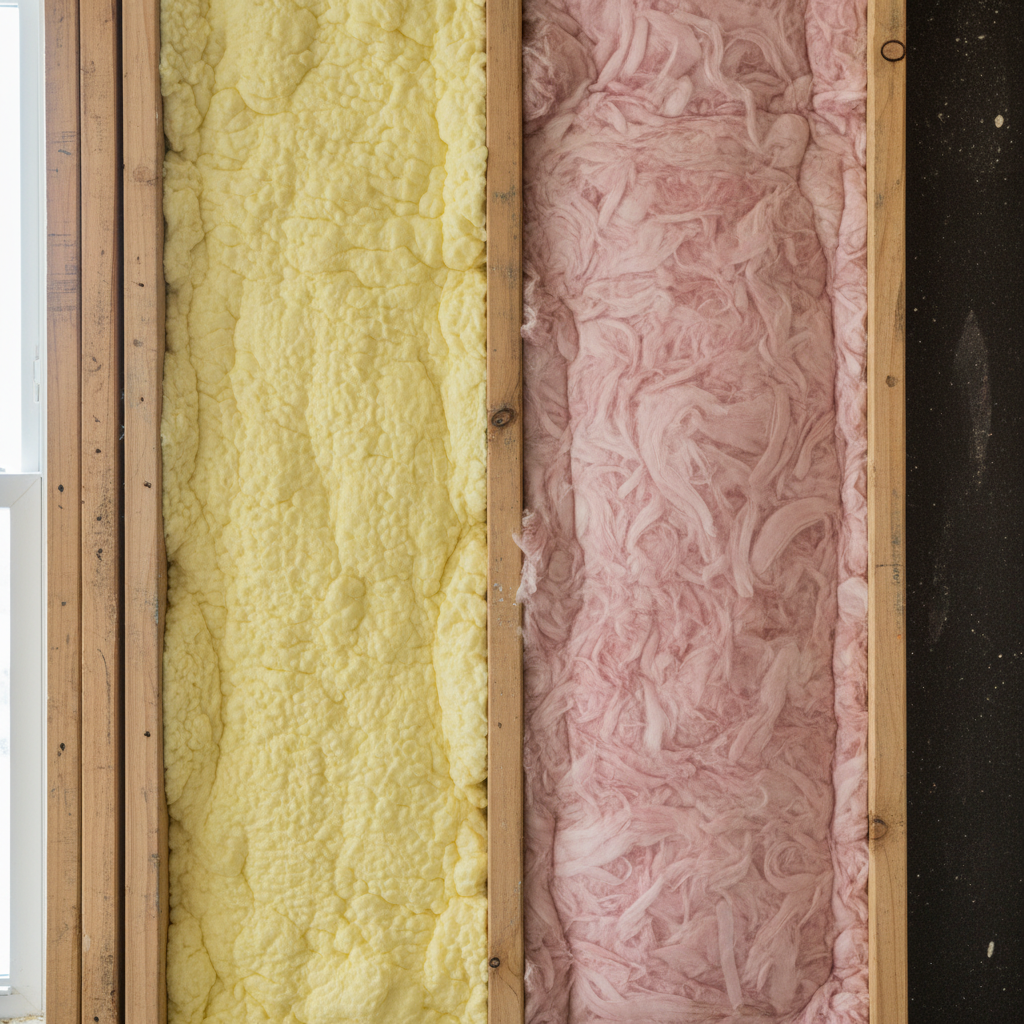
Spray Foam Insulation: The Complete Homeowner Guide
Everything you need to know about open-cell vs. closed-cell spray foam — costs, R-values, best applications, and why it outperforms traditional insulation.

Spray Foam Insulation: The Complete Homeowner Guide
If you've been researching insulation options, you've probably heard that spray foam is the gold standard. And for good reason — it outperforms fiberglass batts, blown-in cellulose, and rigid board in almost every measurable category. But not all spray foam is the same, and choosing the wrong type for your application can cost you money.
This guide breaks down everything you need to know before calling a contractor.
What Is Spray Foam Insulation?
Spray polyurethane foam (SPF) is a two-component chemical mixture that expands on contact to fill cavities, seal air gaps, and create a continuous thermal barrier. Unlike batts or blown-in insulation, spray foam adheres directly to surfaces — meaning it doesn't sag, shift, or leave gaps over time.
There are two main types: open-cell and closed-cell. They look similar during installation but behave very differently.
Open-Cell vs. Closed-Cell: What's the Difference?
Open-Cell Spray Foam
Open-cell foam has a soft, spongy texture because its cells are intentionally left open after expansion. This makes it:
- Lightweight and flexible — great for interior walls and sound dampening
- Lower R-value — approximately R-3.5 to R-4 per inch
- Vapor-permeable — moisture can pass through (may require a vapor barrier in some climates)
- More affordable — typically costs less per board foot than closed-cell
Best applications: interior walls, attic ceilings (when vapor control is managed), soundproofing between floors.
Closed-Cell Spray Foam
Closed-cell foam is dense and rigid because its cells are sealed and filled with a blowing agent. This makes it:
- High R-value — R-6 to R-7 per inch, the highest of any insulation type
- Vapor barrier — acts as a Class II vapor retarder at 2 inches or more
- Structural reinforcement — adds measurable racking strength to wall assemblies
- Moisture and flood resistant — won't absorb water or support mold growth
Best applications: crawl spaces, rim joists, exterior walls, rooflines, below-grade applications, and anywhere moisture is a concern.
R-Value: Why It Matters More Than Thickness
R-value measures thermal resistance — the higher the number, the better the insulation. Here's how spray foam compares:
| Insulation Type | R-Value Per Inch |
|---|---|
| Closed-cell spray foam | R-6 to R-7 |
| Open-cell spray foam | R-3.5 to R-4 |
| Fiberglass batt | R-2.9 to R-3.8 |
| Blown-in cellulose | R-3.2 to R-3.8 |
| Rigid foam board | R-3.8 to R-6.5 |
In a 2x4 wall cavity (3.5 inches), closed-cell foam achieves R-21 to R-24 — compared to R-13 for a standard fiberglass batt. That's a significant difference in a typical home.
The Air Sealing Advantage
Here's what most homeowners don't realize: air leakage accounts for 25–40% of heating and cooling losses in a typical home. Fiberglass batts do nothing to stop air movement — they only slow conductive heat transfer.
Spray foam does both. It insulates and air seals in a single application, eliminating the drafts, cold spots, and moisture problems that come with air infiltration.
This is why homes insulated with spray foam often see 30–50% reductions in energy bills — not just from the R-value, but from eliminating air leakage entirely.
Where Spray Foam Makes the Most Impact
Attics and Rooflines
Attics are responsible for the largest heat loss in most homes. Spray foam applied to the underside of roof decking creates a conditioned attic space, keeping HVAC equipment and ductwork within the thermal envelope.
Crawl Spaces
Crawl spaces are notorious for moisture, mold, and cold floors. Closed-cell foam on crawl space walls and rim joists creates a sealed, conditioned space that eliminates these problems permanently.
Rim Joists
The rim joist — where your floor framing meets the foundation — is one of the most air-leaky areas in any home. A few inches of closed-cell foam here delivers an outsized return on investment.
Existing Walls (Retrofit)
Blown-in spray foam can be injected into existing wall cavities through small holes, making it ideal for retrofit insulation projects without major demolition.
What Does Spray Foam Cost?
Spray foam costs more upfront than fiberglass or blown-in insulation. Typical ranges:
- Open-cell: $0.44–$0.65 per board foot installed
- Closed-cell: $1.00–$2.00 per board foot installed
For a 1,500 sq ft home, a full spray foam insulation project might run $8,000–$20,000 depending on scope, access, and the type of foam used.
However, most homeowners recoup this investment through energy savings within 3–7 years — and the insulation lasts the life of the building with no maintenance.
Is Spray Foam Right for Your Project?
Spray foam is the right choice when:
- You want maximum energy performance
- Moisture or air sealing is a concern
- You're insulating a crawl space, rim joist, or roofline
- You're doing new construction and want a high-performance building envelope
- You're tired of drafts, cold floors, or high utility bills
It may not be the best fit when budget is the primary constraint and the application doesn't require air sealing — in those cases, blown-in insulation or fiberglass batt insulation may deliver adequate performance at lower cost.
Work With a Certified Spray Foam Contractor
Spray foam installation requires specialized equipment, proper mixing ratios, and experience with building science. Improper installation can result in off-ratio foam, odor problems, or inadequate coverage.
ApexSeal NY's crews are trained and certified in spray polyurethane foam application, serving homeowners and contractors across New York, New Jersey, Connecticut, and Pennsylvania. Learn more about our spray foam insulation service or explore all insulation services we offer.
Not sure if spray foam is right for your project? You might also want to read our guides on blow-in insulation for existing homes and how insulation cuts energy bills by 30%.
Ready to get started? Contact us for a free estimate — we'll assess your home, recommend the right product, and give you a clear, detailed quote.
Explore Topics
Written by
ApexSeal NY
Content creator and writer sharing insights and stories.