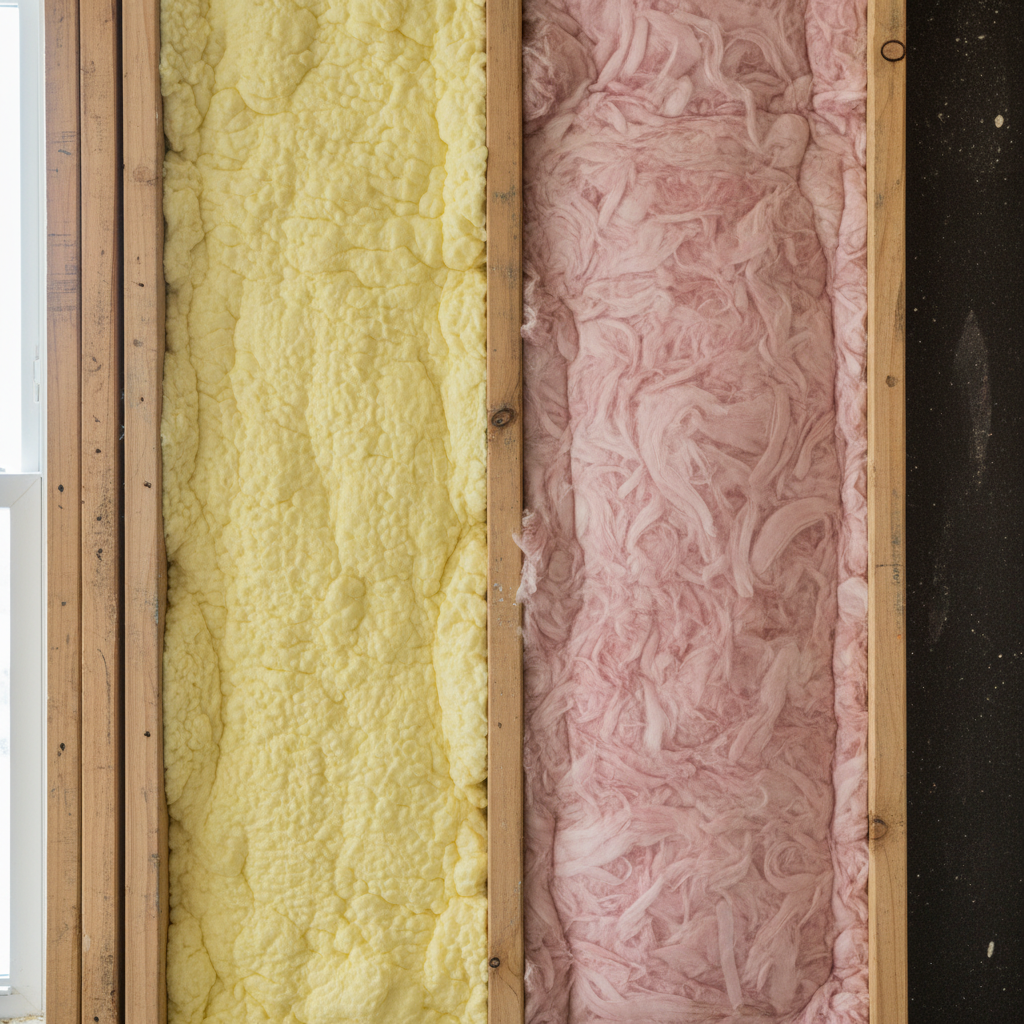
Spray Foam vs Fiberglass Insulation: Which Is Right for Your NY/NJ Home?
Comparing spray foam and fiberglass insulation on R-value, air sealing, moisture resistance, cost, and lifespan — so NY and NJ homeowners can make the right call.

Spray Foam vs Fiberglass Insulation: Which Is Right for Your NY/NJ Home?
When it comes to insulating a home or commercial building in New York or New Jersey, two options dominate the conversation: spray foam and fiberglass. Both are widely used, both have real advantages — and both have situations where they fall short. If you're trying to decide between them, this guide gives you a clear, honest comparison so you can make the right call for your project.
R-Value: How Well Does Each Insulate?
R-value measures thermal resistance — the higher the number, the better the insulation performs per inch of thickness.
- Closed-cell spray foam: R-6 to R-7 per inch
- Open-cell spray foam: R-3.5 to R-4 per inch
- Fiberglass batts: R-2.9 to R-3.8 per inch
- Blown fiberglass: R-2.2 to R-2.7 per inch
Closed-cell spray foam delivers the highest R-value per inch of any common insulation material. That matters in older NY and NJ homes where wall cavities are shallow — you can hit code-required R-values without losing interior square footage.
Fiberglass can still reach adequate R-values in standard 2×6 wall framing or open attic floors, but it requires more depth to get there.
Air Sealing: The Factor Most Homeowners Miss
R-value alone doesn't tell the whole story. Air infiltration — drafts moving through gaps, cracks, and penetrations — can account for 25–40% of a home's heating and cooling losses. This is especially relevant in the Northeast, where winters are harsh and older housing stock is full of air leaks.
Spray foam wins decisively here. When applied, it expands to fill every gap, crack, and irregular surface. Closed-cell foam creates a rigid, airtight barrier. Open-cell foam fills cavities completely and seals around framing, wiring, and pipes.
Fiberglass does not air-seal. Batts and blown fiberglass slow heat transfer but allow air to pass through and around them. To get meaningful air sealing with fiberglass, you need a separate air barrier — house wrap, rigid foam board, or spray-applied membrane — which adds cost and labor.
For homeowners in Rockland County NY, Westchester County NY, and Bergen County NJ dealing with drafty older homes, this distinction often determines which product actually solves the problem.
Moisture Resistance
The Hudson Valley and tri-state region see significant humidity swings between seasons. Moisture management matters.
Closed-cell spray foam has a very low vapor permeability (around 0.8 perms at 2 inches). It acts as both an insulator and a vapor retarder, making it well-suited for below-grade walls, crawl spaces, and rim joists where moisture intrusion is a real risk.
Open-cell spray foam is vapor-permeable and should not be used in below-grade or high-moisture applications without a separate vapor control layer.
Fiberglass is not moisture-resistant. It does not absorb water itself, but it holds moisture within the cavity if the surrounding assembly isn't properly detailed. Wet fiberglass loses R-value and can promote mold growth in the framing behind it — a common issue in older homes across Long Island NY and Orange County NY.
Cost Comparison
This is where fiberglass has a clear advantage for budget-conscious projects.
| Material | Installed Cost (per sq ft) |
|---|---|
| Fiberglass batts | $0.50 – $1.50 |
| Blown fiberglass | $1.00 – $2.00 |
| Open-cell spray foam | $1.50 – $3.00 |
| Closed-cell spray foam | $3.00 – $6.00 |
Ranges reflect typical NY/NJ market pricing and vary by project scope, access, and existing conditions.
Spray foam costs more upfront. However, the energy savings from improved air sealing often offset that premium over 5–10 years, particularly in homes with high heating and cooling loads. Many homeowners in Fairfield County CT and Pike County PA who upgrade from fiberglass to spray foam report 20–35% reductions in utility bills.
Lifespan and Durability
Spray foam — both open-cell and closed-cell — is a permanent installation. It does not sag, settle, or degrade over time. Properly installed closed-cell foam can last the life of the building.
Fiberglass batts can sag and compress over time, especially in vertical wall cavities. Blown fiberglass settles, which reduces its effective R-value. In attics, settling of 10–20% is common over 10–15 years without topping off.
Best Use Cases for Each
When Spray Foam Makes Sense
- Rim joists and band joists — small, irregular spaces where air sealing is critical
- Crawl spaces — closed-cell foam on walls and floor creates a conditioned, moisture-resistant enclosure
- Attic rooflines (unvented assemblies) — spray foam applied to the underside of roof decking creates a tight thermal envelope
- Older homes with significant air leakage — spray foam addresses both insulation and infiltration in one step
- Commercial and mixed-use buildings — where performance requirements and long-term durability justify the investment
When Fiberglass Makes Sense
- New construction with tight framing — when the building envelope is already well-detailed and air-sealed separately
- Budget-constrained projects — fiberglass delivers adequate performance at lower upfront cost
- Open attic floors — blown fiberglass at sufficient depth (R-38 to R-60) performs well in accessible attic decks
- Interior partition walls — for sound attenuation where thermal performance is secondary
Which Should You Choose?
There's no universal answer — it depends on your building type, budget, existing conditions, and performance goals.
For most older homes in New York and New Jersey, spray foam delivers better long-term results because it addresses air sealing and insulation simultaneously. For new construction with a well-detailed air barrier already in place, fiberglass can be a cost-effective choice — especially in open attic applications.
Many projects use both: spray foam at the rim joist, crawl space, and roofline, with blown fiberglass on the attic floor. A hybrid approach often delivers the best balance of performance and cost.
Get a Professional Assessment
The right answer for your home depends on factors a contractor needs to evaluate in person — existing insulation, air leakage points, moisture history, and your energy goals. ApexSeal Group provides free quotes for homeowners and general contractors throughout Rockland County NY, Orange County NY, Westchester County NY, New York City, Long Island NY, Bergen County NJ, Fairfield County CT, and Pike County PA.
We install both spray foam and fiberglass insulation, and we'll recommend the right solution for your specific project — not the most expensive one.
Contact ApexSeal Group to schedule your free assessment.
Explore Topics
Written by
ApexSeal Group
Content creator and writer sharing insights and stories.